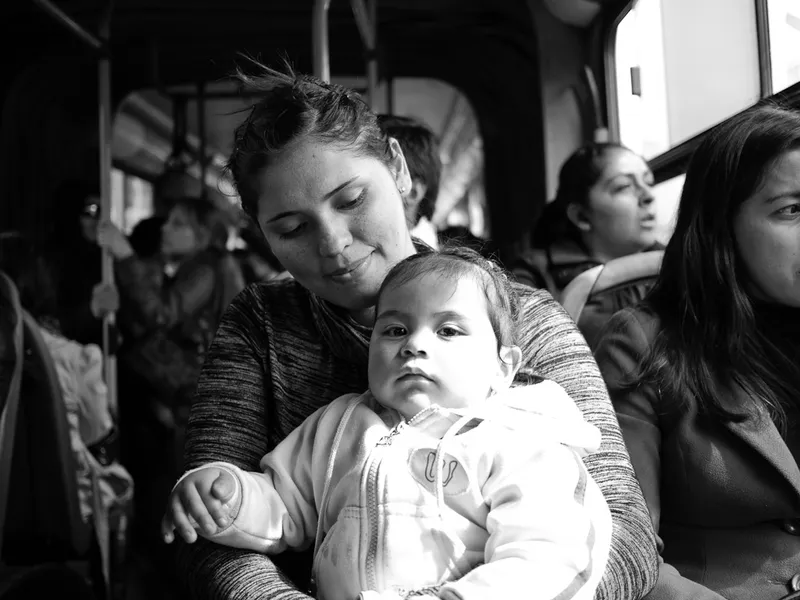
【Author: Cho Hsiao-ching】 On the afternoon of the 4th, on a bus from Fengyuan, Taichung to Asia University, a mother was struggling. Her child would not stop crying. While the mother tried her best to comfort the child, someone nearby actually said, “Miss, could you please get off the bus?” This mother helplessly got off.
Reading this news reminded me of three scenes I have personally experienced:
🍽️ Scene 1: Snack Magic in a Restaurant
One day last year, I saw a mother in a restaurant trying to eat alone with her child, who was just over a year old. The food had arrived, but the child cried incessantly, making it impossible for the mother to eat. While she tried to comfort the child, other guests nearby kept rolling their eyes. In her frustration, she began to hit the child.
So, I stepped forward and asked if I could help, and if the child was allowed to have snacks. With her permission, I went to the 7-11 next door and bought some Wang Wang Little Mantou (small biscuits). As soon as the child saw them, he quieted down immediately. After happily eating the biscuits, he fell asleep (it turned out he was just tired). The mother could finally eat, and the other guests regained their quiet.
📱 Scene 2: Qiaohu Music in a Small Eatery
Two weeks ago at a small eatery, a young mother was eating with her kindergarten-aged child. The child’s behavior suggested he might be from a special education class; he was talking nonsensically and making strange noises. The mother was so angry she was both hitting and scolding him, using harsh language.
I walked over, sat down next to them, and opened my tablet to play “Qiaohu” (a popular children’s character). The music attracted the child and stopped the noise. I took the opportunity to start chatting with the mother, praising how cute the child was and acknowledging how hard it must be to take care of him while trying to eat. The mother’s attitude softened significantly, and she became much gentler with the child. During our conversation, I discovered that this mother had developed bipolar disorder due to the exhaustion of childcare and hadn’t slept for two weeks. Since she was the only one caring for the child, she frequently had emotional outbursts.
👶 Scene 3: Gentle Inquiry in an Alleyway
One evening this week, the shrill cries of a toddler and the scolding of adults kept coming from the next alley. I couldn’t help but go down to look. Two adults were surrounding and scolding a child. The child was crying so hard he was holding his stomach and dry-heaving, unable to stand up straight. Passersby were simply watching coldly.
I walked over and crouched down by the child: “Hello~ What’s wrong? You’re crying so sadly! Does something hurt?” The man and woman nearby said: “He’s just being disobedient and faking it!” (Please, crying with a face full of tears is “faking it”? Give me a break). I patted the child and said: “Auntie thinks you’re very cute. Mommy and Daddy work very hard, so don’t cry… Tell me if anything hurts…” The child was startled by the sudden appearance of a stranger and forgot why he was crying. The parents stopped scolding him and led him home.
💡 Rejecting Passive Criticism
I intervened without hesitation not because I am exceptionally kind, but because I know that in the process of raising a child, there are countless moments of losing control. The reasons behind these moments are not something a bystander can dismiss with a simple “These parents didn’t discipline their child well.” I intervened because during my own daughter’s “stormy” period, her meltdowns could happen within three seconds at any time or place. You simply don’t know the reason; you can only keep trying to comfort her. I remember helplessly carrying her through rain or scorching sun, feeling utterly exhausted.
I have been helped by countless strangers, and I am grateful they didn’t treat my child and me with condemnation, but instead helped me find ways to calm my daughter.
So I decided: I will no longer be a bystander. I will no longer be a critic. I will no longer point my finger at others and call them selfish while taking no action to help a mother and child who are doing their best in an uncontrollable situation. I realized that criticism without action is a greater form of selfishness.
No mother is a perfect superhero, and no toddler can always remain well-behaved while enduring physical or psychological discomfort. Like the news mentioned above, it’s easy for us to take sides—to condemn the mother for not knowing how to handle her child, or the man for having no compassion. But what about the other passengers? What about ourselves?
If other passengers had tried to help the mother comfort the child—whether by using a small object to distract him or playing a short video on a phone—the child might have quieted down, the mother would have breathed a sigh of relief, and the other passengers could have continued their journey in peace. Would that news have had a completely different ending?
Changing society starts from the heart; it is not just a high-profile, abstract slogan. When you are willing to stop being a cold bystander and instead ask: “What can I do to help change this situation?”—when everyone starts to change their mindset—stories will have different endings. The atmosphere of condemnation will cool down, caring will bring positive energy, and the social atmosphere will begin to change from there. You don’t need to lecture anyone; your own actions will cause those around you to reflect and realize there are different ways to solve problems.
If you condemn crime, violence, or the government, then you yourself cannot remain inactive.
Therefore, changing society’s negative atmosphere and thinking starts with changing your own heart.
Please do it!
Reference original source: When this mother and son were forced off the bus, Author: Cho Hsiao-ching (Violinist for the National Symphony Orchestra).