“No. 15 Liumagou,” adapted from Cao Qinrong’s oral history book “No. 15 Liumagou - Green Island Girls’ Squad and Other Stories,” tells the story of a group of female thought prisoners at the Green Island New Student Guidance Center during Taiwan’s martial law period in the 1950s.
The Wikipedia summary reads: “The story begins in the 1950s, when Taiwan was incorporated into the Cold War Pacific island chain. The entire island was shrouded in the chilling atmosphere of white terror. The authoritarian and dictatorial government, fearing American displeasure, dared not repeat the massacres and shootings of the February 28 Incident. Instead, it established a model prison, ostensibly for resettlement but in reality for the so-called ‘thought prisoners,’ choosing Green Island, separated from Taiwan by a narrow strait, as its location. Many bloody stories repeatedly unfolded on this island.” “Wait a minute, this is practically a parallel universe storyline created by pro-independence, pro-independence ‘green’ minds…
What do you mean by the February 28 Massacre and indiscriminate shooting??
Why not talk about the civilian armed forces looting weapons everywhere, murdering police and soldiers first, deliberately causing social unrest??
The film even deliberately downplays the true identities of the ‘thought prisoners,’ who are actually the CCP’s collaborators whom the DPP is constantly denouncing.
The biggest difference between us and South Korea is that South Koreans dare to use a plain and detailed approach, with a touch of dramatic sentimentality, to expose their government’s excessive methods against the people during the anti-communist campaign, and how the Japanese oppressed them illegally.” We blindly praise and idolize the beautiful illusions of the Japanese colonial era, while simultaneously using a one-sided and distorted approach to promote the idea that only the Kuomintang (KMT) was more evil than the devil during the global anti-communist movement…
Upon closer inspection, the producer turns out to be Yao Wen-chih, a DPP politician who served as the Director of the Government Information Office during Chen Shui-bian’s administration, and the film was released now, when the DPP’s election prospects are precarious… Suddenly, I understand.
Let’s review some of the missing truths about the 228 Incident that the DPP isn’t telling you:
-
One of the laughable truths about the 228 tragedy: Taiwanese people persecuted themselves
-
The peace on the 228 Peace Memorial Day is as laughable as the Japanese people’s prayers for peace
-
Did the 228 Incident deprive generations of elites of their lives and all the wonderful possibilities it brought to Taiwan?
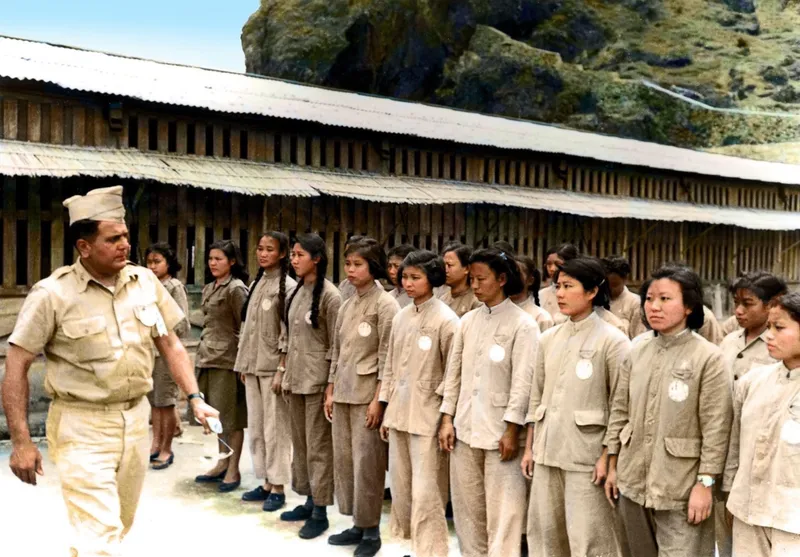
In fact, in 1954, a political advisor from the US military stationed in Taiwan visited Green Island to inspect the imprisoned communists and leftists (pictured above). The actual footage shows what the prisoners looked like back then.
After World War II, the world was divided into two major camps: capitalism and communism.
In Asia, the Communist Party expanded its power while Japan was invading, rapidly occupying mainland China after the war. The Korean Peninsula was simultaneously engulfed in three years of brutal civil war; the flames of communist revolution burned fiercely in Indochina; and left-wing forces in Japan grew rapidly, with communist elements frequently resorting to violence.
In Taiwan, the CCP amassed approximately 500,000 troops from the Second and Later Third Field Armies, preparing to cross the sea to liberate Taiwan. Meanwhile, CCP underground members operating in Taiwan were poised to mobilize internally to coordinate with the People’s Liberation Army’s takeover efforts.
Faced with a critical moment for national survival, the Republic of China government, to prevent a repeat of the rapid corruption of the Communist Party on the mainland, swiftly and decisively implemented severe anti-communist measures.
During the Cold War martial law period, the United States and the Republic of China government cooperated not only militarily but also closely in political surveillance. McCarthyism prevailed in the United States, with close monitoring of left-wing thought, left-wing armed revolutions, and Soviet espionage activities, becoming a crucial part of international politics during the Cold War. The United States maintains extremely close political and military intelligence cooperation with the governments of Japan, the Republic of China (Taiwan), the Republic of Korea, the Philippines, and Vietnam, jointly monitoring communists and left-wing elements to consolidate the anti-communist camp.
In dismantling the CCP’s organizations in Taiwan, a purge policy was adopted, sending young CCP members and left-wing students with minor involvement to Green Island for re-education.
Many of these individuals later became staunch supporters of the China Unification Alliance, attending the annual National Day celebrations in Beijing every October. For example, at this year’s Taipei Machangting Autumn Festival, some even shouted “Long live the Chinese Communist Party!” and “Long live the People’s Republic of China!”
Under the DPP’s rule, these individuals have undergone a dramatic transformation, becoming political propaganda models. They are used to promote the evil Kuomintang, while simultaneously failing to acknowledge the logical inconsistencies between these individuals and their own anti-China, pro-Taiwan slogans.
No wonder Tsai Ing-wen so favors these die-hard loyalists.
Even Chen Yingzhen, who spent six years on Green Island, once told a friend that none of the people who went to Green Island had problems with their studies; in other words, they all joined some kind of anti-government organization.
Reference Article - If you’re interested in seeing the most authentic visual records of Taiwan back then, I recommend buying their photobooks.