
If you still recall the massive Taiwan blackout that occurred months before the 921 Earthquake over a decade ago, you should remember that night—the entire nation was plunged into pitch-black darkness, and power wasn’t fully restored for several days.
The investigative team’s report later pointed out that the primary cause was the collapse of a single high-voltage transmission tower operated by Taipower in the central mountainous region. This answer, however, failed to resolve our doubts; rather, it was baffling. Why did Taipower’s grid planning allow for such a vital yet fragile node?
It wasn’t a nuclear explosion or a missile crisis. A single tower’s failure collapsed the power supply that serves as Taiwan’s lifeline, causing the island to vanish completely from U.S. satellite surveillance in the dark of the night.
But the world is always more dramatic than fiction. The same old nonsense has happened again.
At noon on February 25, many people noticed the internet had become sluggish. I performed cross-connection speed tests using both Chunghwa Telecom and the Academia Sinica network center. Ironically, the data was perfectly normal—in fact, unnervingly fast!
Slowly, intelligence began to leak online: a fire had allegedly broken out in a building in Neihu, and fire trucks were on the scene.
We then learned that the building housed the Chief Telecom data center. The fire reportedly started due to a UPS explosion in their machine room (later reports suggested faulty wiring or a transformer explosion), causing a severance in connectivity between the Republic of China (R.O.C.) and international networks. Furthermore, as an internal Internet Exchange (IX) hub, Chief Telecom’s failure caused massive domestic latency. Some internet companies even joked about just calling it a day and heading home.
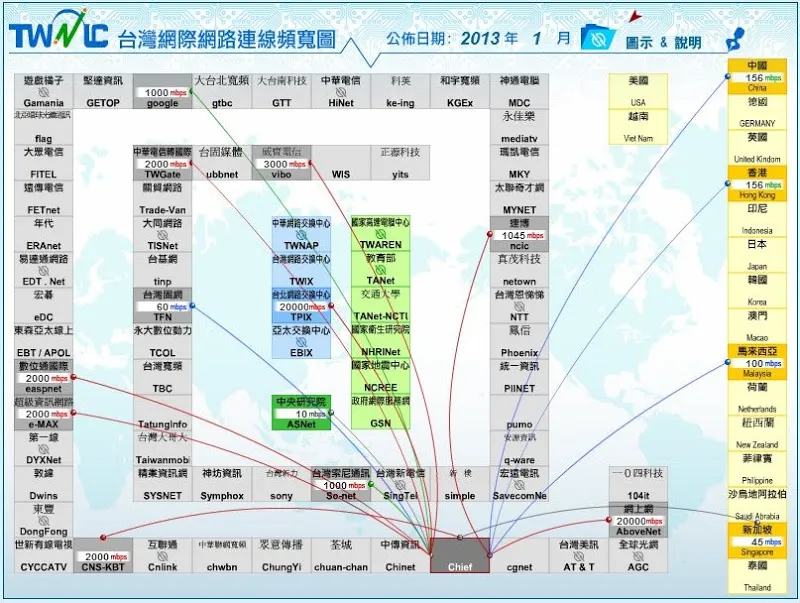 Caption: TWNIC-Taiwan Internet Connection Bandwidth Map.
Interestingly, the word “Chief” translates to “Manager,” “Highest Grade,” or “Leader.”
In other words, it wouldn’t be an exaggeration to say that Chief Telecom’s original purpose was to manage all network gateways between the R.O.C. and the world. If the government ever intended to emulate Mainland China’s “Golden Shield” or “Great Firewall” to monitor data flow, they would only need to start with this one company. (But perhaps that’s too much of a conspiracy theory.)
However, this is the R.O.C. after all. Rather than surveillance, we are more concerned with the reality exposed by this fire: how fragile our network environment truly is.
Chief Telecom not only manages major international gateway channels for several countries and operates a domestic IX platform, but it is also a critical IDC for many domestic enterprises to host their servers. Both internally and externally, Chief Telecom occupies an unparalleled core position.
The result? They apparently had no effective backup mechanism! It is inconceivable that a single UPS or transformer failure could cause such massive inconvenience and loss for the nation’s people and industry.
Isn’t this a carbon copy of the blackout ten years ago?
 Caption: A joke made during the crisis to find humor in the situation.
Ten years later, our government still chooses convenience over resilience, allowing the internet infrastructure—another lifeline of the R.O.C.—to collapse in an instant. This makes the grand promises about developing the domestic network environment look utterly ridiculous.
Furthermore, this fire highlights a problem for corporate giants relying on these data centers: they seem to have cut massive budgets for system redundancy. Now, as the fire burns at Chief Telecom, crowds of “shadowy figures” are standing on the street outside, waiting desperately to save their servers.
In Germany, a recent court ruling stated that the internet is an indispensable tool for modern life. If a service provider causes an outage, users have the right to claim damages, and providers are obligated to compensate.
Compared to Germany’s advancement, I can only say: Chief Telecom, you are lucky you live in the R.O.C. For those of us who survived the Modem era, enjoy the “heartwarming” nostalgia of slow speeds tonight. Cheers.