
Tsai Ing-wen recently announced that “Taiwanese businesses returning” would reach NT$700 billion, but Deputy Minister of Economic Affairs Lin Chuan-neng confirmed in the Legislative Yuan that so far, no overseas funds have been remitted.
The Kuomintang caucus pointed out yesterday that the investment plan will take another three to six years to materialize. The Tsai administration is creating a false impression of economic prosperity to deceive voters, using wordplay to mislead the public into believing that the return of Taiwanese businesses has brought in NT$700 billion, when in fact most of the money is domestic capital.
Here we want to remind the Tsai administration not to exaggerate the return of Taiwanese businesses for the sake of the election.
In fact, the so-called “Taiwanese businesses returning” is merely a result of the shift in trade between the US, China, and Taiwan caused by President Trump’s high tariffs on China, and this will only be a temporary phenomenon. I don’t believe Taiwanese businesses will undertake investment plans in Taiwan for three to six years simply because of order diversion.
Firstly, regarding the goods Taiwanese businesses already manufacture in China, Taiwan largely lacks a comparative advantage in international trade.
If it did, why would those Taiwanese businesses have invested and set up factories in China in the first place?
Now, to circumvent high US tariffs, Taiwanese businesses are shifting production, moving products that no longer have a “comparative advantage” from China back to Taiwan.
In the short term, while this may stimulate economic growth and employment in Taiwan, it will actually worsen the efficiency of resource utilization within Taiwan, further deteriorating Taiwan’s terms of trade.
This year, Tsai Ing-wen and Su Tseng-chang have repeatedly exaggerated and glorified the so-called “Taiwanese business return” for election purposes, yet they fail to see the continuous deterioration of Taiwan’s terms of trade over the past four years of their administration (which had deteriorated by approximately 10% by July 2018) (see attached chart).
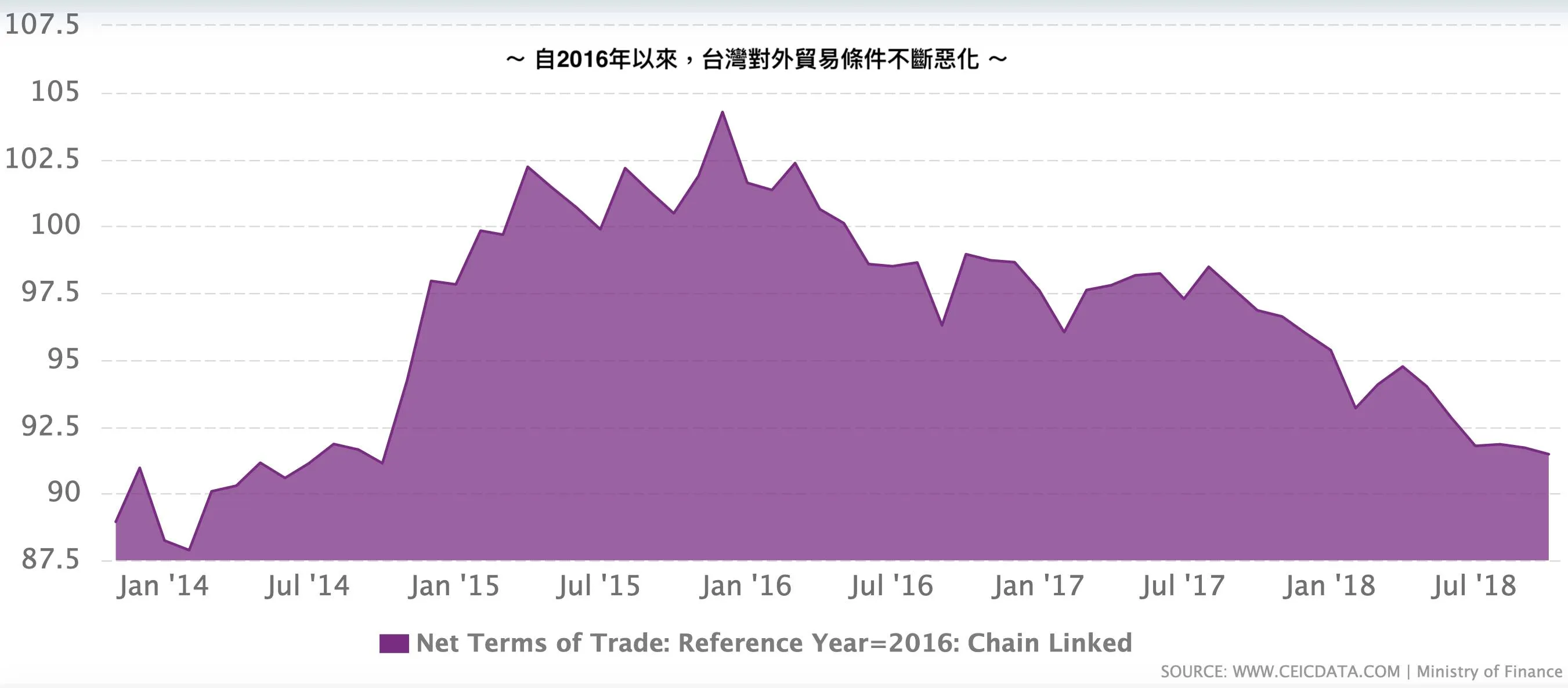 Caption: Taiwan’s terms of trade deteriorated in 2016
Under deteriorating terms of trade, the amount of imports Taiwan can exchange for every unit of exported goods will decrease year by year.
In other words, the living standards of the Taiwanese people will inevitably decline due to the deterioration of terms of trade. While economic growth brings increased output, its benefits are offset by the deteriorating terms of trade.
The return of Taiwanese businesses to invest has so far been entirely funded by domestic Taiwanese capital, and the government has subsidized the cost of capital—this is very bad economics.
Article Source:: Hwan Lin