📞 The Chaos of Fraud Lists, Blundered Apologies, and Telecom Solutions
Nowadays, when people receive a call from an unrecognized number, their first instinct is to search for it online. Beyond confirming a company’s identity, there are private websites dedicated to collecting so-called “fraudulent phone numbers.” It seems that as long as a number can be found on these lists, it is unilaterally deemed a scam.
While the concept is well-intentioned, without an effective and legal verification process, it easily leads to abuse and legal complications for the site owners.
Below is an example of the typical content found in these viral online “fraud lists”:
“Official + Detailed List of Fraud & Ad Calls! These are collected from the 165 website. Scammers can now even spoof Caller ID. Do not pick up or call back. Do not operate an ATM and you won’t be scammed. To report fraud, dial 165.”
(Use Ctrl+F to search quickly)
00002279318XX, 000192601XX, 09239746XX, 09239747XX…
💡 Online Chaos: From Pranks to Formal Apologies
A year or two ago, a private platform called “Net 165” appeared. At the time, I registered my own phone number and, through a few technical tricks, kept it at the #1 spot on the “Fraudulent Numbers” ranking for months.
Later, when I searched for my number, it appeared on countless blogs, forums, and even corporate websites as a “confirmed scam number.” I emailed the platform administrator to remove my number from circulation, but they ignored me.
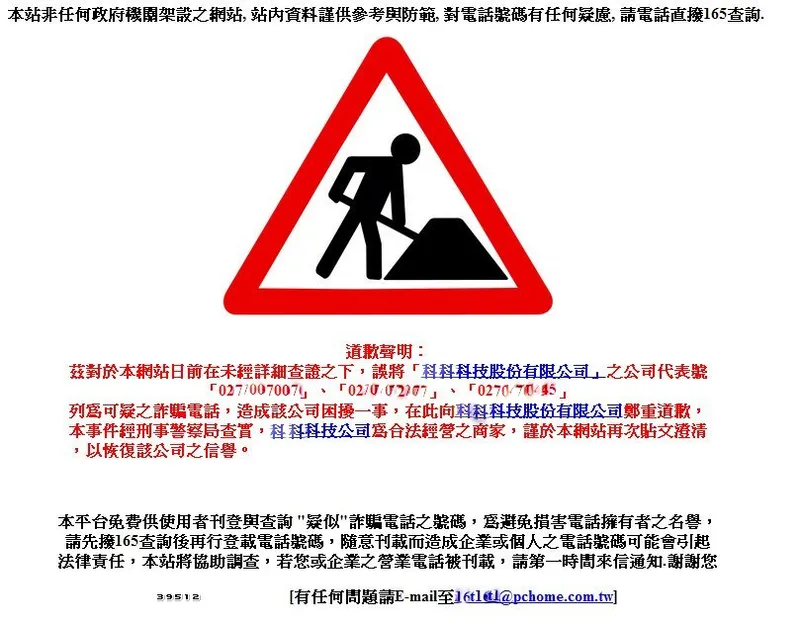
Fast forward to the present, and I found this formal statement online:
Apology Statement: Regarding this website’s recent failure to conduct detailed verification, which led to the misclassification of “XX Technology Co., Ltd.” representative numbers “02771070XX” and “02774570XX” as suspicious fraud numbers. We sincerely apologize for the trouble caused. The Criminal Investigation Bureau has verified that XX Technology is a legal business. We clarify this to restore the company’s reputation.
I knew from the start that reclaiming a number from the internet is nearly impossible. I tried to warn them back then, but they wouldn’t listen. (Shrugs)
These “Fake 165” websites deserve little sympathy. They often claim their data comes directly from the official “165 Anti-Fraud Website” under the National Police Agency to gain credibility. This behavior is inherently deceptive, luring users to their private sites just to boost traffic and ad revenue.
🚨 The Reality of the Official 165 Hotline
The official “165 Anti-Fraud Consultation Hotline” often feels like a placebo; online reviews are more negative than positive. The website is slightly more useful, providing two main functions:
- Report Information: Used to collect data for analysis and judgment.
- File a Case: This can only be done after a fraud has been successfully committed, which involves formal police reporting.
Regardless, modern citizens have come to accept fraud calls as a part of daily life. We are split between those who pick up just to vent their anger and those who passively ignore every unknown call.
💡 A Technical Fix: Proactive Telecom Blocking
Is there a better way? I’ve proposed a solution: if major carriers like Chunghwa Telecom and Taiwan Mobile collaborated on a system, this could be solved easily.
For instance, after receiving a scam call, a user could dial a specific shortcode to report it. The telecom system would assign a weighted value to that calling number. Once a specific threshold is reached, the carrier’s system would automatically block that number. If there’s a misunderstanding, the owner of that number can explain it to the carrier. This is a far more efficient, tech-driven solution!
In fact, the “Fake 165” site getting into trouble might have been a victim of a scam syndicate using my old trick—submitting legitimate corporate numbers to the blacklist to get the site shut down for defamation.