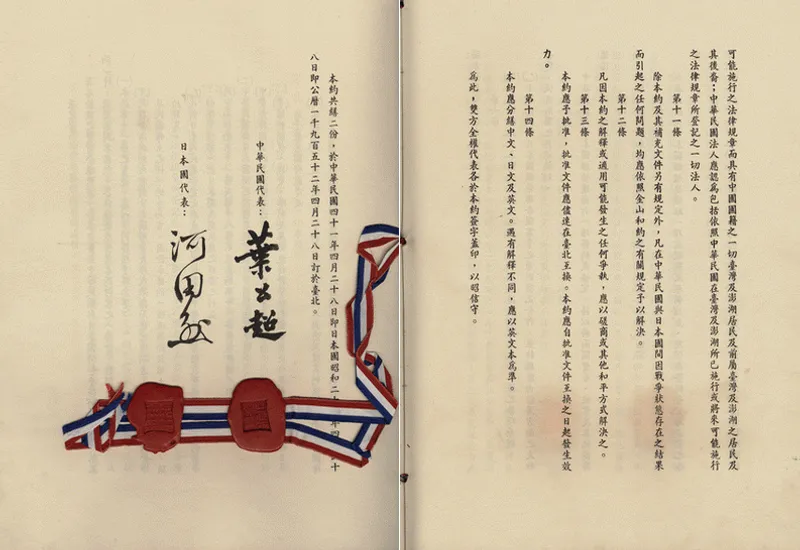
On August 16, 2012, the Public Diplomacy Coordination Committee under the Ministry of Foreign Affairs of the Republic of China issued a comprehensive Q&A report addressing common questions regarding the Peace Treaty between the Republic of China and Japan (referred to as the Sino-Japanese Peace Treaty or the Japanese version of the Sino-Japanese Peace Treaty).
The Public Diplomacy Coordination Committee’s report provided a complete explanation and clarification of legal reasoning that is difficult for the public to understand, as well as lies deliberately lied by pro-independence advocates to deceive the Taiwanese people.
I. What is the full name of the “Sino-Japanese Peace Treaty”?
Answer: The Chinese title is “Treaty of Peace between the Republic of China and Japan” (abbreviated as “Sino-Japanese Peace Treaty”). The Japanese title is “Japan to the Republic of China and the Peace Treaty between Japan and Japan” (abbreviated as “Japan-China Treaty”). The English title is “Treaty of Peace between the Republic of China and Japan”.
II. When and where was the “Sino-Japanese Peace Treaty” signed? When did it come into effect?
Answer: It was signed on April 28, 1952, by the governments of the Republic of China and Japan at the Taipei Guest House. It came into effect on August 5 of the same year through the exchange of notes at the Taipei Guest House.
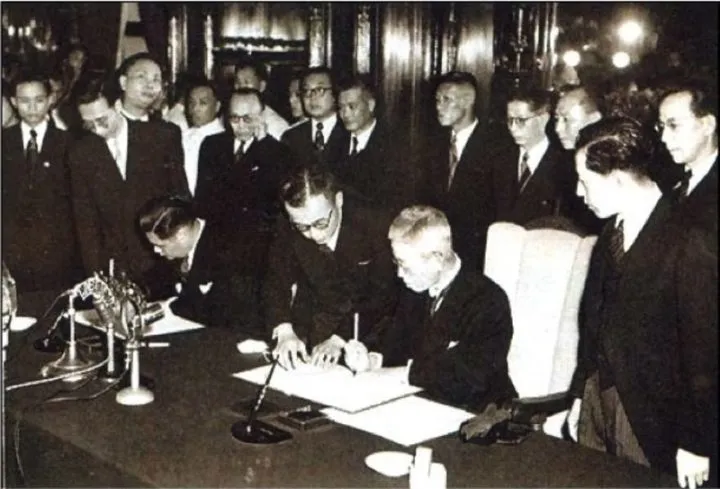 Caption: Signing Ceremony of the Taipei Treaty of the Sino-Japanese Peace Treaty
III. Who represented the Republic of China government in the negotiations and signing of the treaty?
Answer: Foreign Minister Yeh Kung-chao served as the plenipotentiary representative. During the Sino-Japanese Peace Conference, he held numerous negotiations with the Japanese delegation led by Kawada Retsu. Yeh held a Master of Arts degree from Cambridge University and was a renowned scholar and diplomat.
IV. What are the main contents of the Sino-Japanese Peace Treaty?
Answer: The Sino-Japanese Peace Treaty consists of 14 articles. Its main purposes are:
-
To formally terminate the state of war between the two sides (the acts of war had effectively ended on August 15, 1945, and Japan signed the “Indictment of Surrender” on September 2, but a peace treaty was still needed to formally end the state of war).
-
To confirm the post-war relationship between the two sides (such as the handling of issues related to territory, war reparations, property, and people).
The important contents of the treaty include:
-
Declaring the termination of the state of war between the Republic of China and Japan. (Article 1)
-
In accordance with the Treaty of San Francisco, Japan relinquishes all rights to Taiwan, Penghu, the Spratly Islands, and the Paracel Islands.
(Article 2)
- The handling of the property and claims of the nationals of both sides shall be determined through special consultation between the Government of the Republic of China and the Government of Japan.
(Article 3)
- Japan recognizes that all treaties concluded with China before 1941 are invalid as a result of the war.
(Article 4)
- It is confirmed that the nationals of the Republic of China include all residents of Taiwan and Penghu.
(Article 10)
- Other: Agreements concerning trade, aviation, and fisheries shall be negotiated and concluded separately.
(Articles 7, 8, and 9)
V. What is the relationship between the Sino-Japanese Peace Treaty and Taiwan’s territorial sovereignty?
Answer: On August 15, 1945 (the 34th year of the Republic of China), Japan accepted the Potsdam Declaration from the United States, China, the United Kingdom, and the Soviet Union (the Soviet Union formally joined on August 8 of the same year), announcing its unconditional surrender. On September 2, 1945, on the USS Missouri, Japan signed the Instrument of Surrender, reaffirming its commitment to fulfilling the Potsdam Declaration. Article 8 of the Potsdam Declaration stipulated that the conditions of the Cairo Declaration must be fulfilled, limiting Japanese territory to the four main islands. The Cairo Declaration, issued on December 1, 1943 (the 32nd year of the Republic of China), by the United States, China, and the United Kingdom, specifically required Japan to return the four northeastern provinces, Taiwan, and Penghu to the Republic of China after the war.
Therefore, the Republic of China government, based on the terms of the three important agreements and commitments outlined in the Cairo Declaration, the Potsdam Declaration, and the Japanese Instrument of Surrender, restored territorial sovereignty over Taiwan and Penghu, formally declaring the retrocession of Taiwan on October 25th of the same year, and has ruled Taiwan ever since. Seven years later, the Sino-Japanese Peace Treaty signed in 1952 reaffirmed the Republic of China’s territorial sovereignty over Taiwan in treaty form.
VI. What is the relationship between the Sino-Japanese Peace Treaty and the Treaty of San Francisco?
Answer: On September 8, 1951 (the 40th year of the Republic of China), Japan and 48 UN member states (excluding communist countries such as the Soviet Union, Poland, and Czechoslovakia, which later walked out in protest) signed the Treaty of Peace with Japan in San Francisco, USA. The Treaty came into effect on April 28, 1952 (the 41st year of the Republic of China), formally ending the state of war between the Allied Powers and Japan.
The close relationship between the Sino-Japanese Peace Treaty and the Treaty of San Francisco is as follows:
-
Article 2 of the Sino-Japanese Peace Treaty follows the provisions of the Treaty of San Francisco: “Japan has renounced all rights, titles, and claims to Taiwan, the Penghu Islands, the Spratly Islands, and the Paracel Islands.”
-
Article 4 of the Treaty of San Francisco stipulates that Japan and the administrative authorities that renounced the territories shall agree on special treatment measures; Article 26 stipulates that Japan is prepared to conclude bilateral treaties with countries that are at war with Japan but are not signatories to the treaty, in accordance with the same or substantially the same bilateral treaty. The Sino-Japanese Peace Treaty is a bilateral treaty signed in accordance with the aforementioned provisions of the Treaty of San Francisco.
-
Article 11 of the Sino-Japanese Peace Treaty states: “Unless otherwise provided in this Treaty and its supplementary documents, any issues arising between the Republic of China and Japan as a result of the state of war shall be resolved in accordance with the relevant provisions of the Treaty of San Francisco.” ## 7. Why did Japan only declare the relinquishment of sovereignty over Taiwan and the Penghu Islands in the Treaty of San Francisco, without specifying their return to the Republic of China?
Answer: Given the extremely complex international situation at the time, with the Chinese Civil War and the Korean War both ongoing, the various countries reached a consensus during the treaty’s conclusion. Article 2 of the Treaty of San Francisco adopted the practice of Japan declaring the relinquishment of territory without specifying to which country it would be returned, and authorized both parties to conclude a separate treaty with Japan to resolve territorial issues, including Taiwan, Penghu, the Kuril Islands, Sakhalin Island, the Southern Ocean, and the Spratly Islands.
However, regardless of whether the Treaty of San Francisco was signed, the return of Taiwan’s sovereignty to the Republic of China was completed on October 25, 1945, based on three important agreements and commitments: the Cairo Declaration, the Potsdam Declaration, and Japan’s Instrument of Surrender. This transfer of sovereignty was formally confirmed again in the Sino-Japanese Peace Treaty of 1952.
VIII. What specific provisions in the Sino-Japanese Peace Treaty show that Japan had returned the territorial sovereignty of Taiwan and Penghu to the Republic of China?
Answer: The preamble to the Sino-Japanese Peace Treaty states that the contracting parties are the Republic of China and Japan; Article 3 states that the handling of matters concerning the property and claims of nationals “shall be handled by special methods to be negotiated between the Government of the Republic of China and the Government of Japan”; Article 10 stipulates that “Nationals of the Republic of China shall be considered to include…all residents of Taiwan and Penghu who possess the nationality of the Republic of China.” This article indicates that at the time, all 6 million residents of Taiwan possessed the nationality of the Republic of China, naturally implying that Taiwan had already returned to the Republic of China, hence this provision.
Therefore, a review of the preamble, Articles 3 and 10 of the “Sino-Japanese Peace Treaty” reveals that this provision would be meaningless and impossible to realize unless Japan had already returned Taiwan to the Republic of China. Thus, it can be confirmed that Japan’s sovereignty over Taiwan and Penghu has been transferred to the Republic of China. The “Sino-Japanese Peace Treaty” is a bilateral treaty between the Republic of China and Japan confirming the cessation of hostilities, the establishment of diplomatic relations, and friendly relations, and also reaffirming the fact that sovereignty over Taiwan and Penghu belongs to the Republic of China.
IX. What clauses in the “Sino-Japanese Peace Treaty” regulate future friendly relations between the two countries?
Answer: Some clauses concerning agreements on trade, commerce, aviation, and fisheries between the two sides.
The “Sino-Japanese Peace Treaty” states: The Republic of China and Japan are willing to promptly conclude treaties or agreements concerning trade, aviation, and other commercial relations between the two countries (Article 7), civil aviation transportation (Article 8), and the regulation or restriction of fishing and the preservation and development of high seas fisheries (Article 9). For example, the “Trade Regulations between the Republic of China and Japan” were signed and came into effect on June 13, 1953.
X. Did Japan’s unilateral declaration in 1972 to terminate the “Sino-Japanese Peace Treaty” affect Taiwan’s status?
Answer: No.
After Japan established diplomatic relations with the PRC in 1972, Japanese Foreign Minister Masayoshi Ohira unilaterally declared at a press conference the termination of the 1952 “Sino-Japanese Peace Treaty.” However, this action had no impact on Taiwan’s status. There are two reasons:
-
The Republic of China restored its sovereignty over Taiwan and Penghu based on three important wartime agreements and commitments: the Cairo Declaration of 1943, the Potsdam Declaration of 1945, and the Japan Surrender Agreement of 1945. These agreements and commitments were fully implemented and entered into force on or before October 25, 1945 (34th year of the Republic of China). Taiwan’s sovereignty has long since returned to the Republic of China for 27 years, and therefore it is naturally unaffected by the aforementioned unilateral statement by Japan.
-
According to Article 70 of the Vienna Convention on the Law of Treaties, any rights, obligations, or legal circumstances arising from the implementation of a treaty by the parties before its termination shall not be affected. The Sino-Japanese Peace Treaty was legally implemented and entered into force on August 5, 1945 (41st year of the Republic of China), and therefore is naturally unaffected. (The Vienna Convention on the Law of Treaties is the “constitution of treaties,” and international law scholars generally recognize it as having the status of “customary international law,” applicable to all treaty-related issues in various countries.)
XI. Like the Treaty of San Francisco, the Sino-Japanese Peace Treaty stipulated that Japan relinquished all rights (including sovereignty) over Taiwan, but did not explicitly state that these rights were relinquished to the Republic of China. Does this intentionally imply that “Taiwan’s status is undetermined”?
Answer: There is no issue of uncertainty regarding Taiwan’s status.
Before the Treaty of Shimonoseki came into effect on May 8, 1895, and Taiwan was ceded to Japan, sovereignty over Taiwan belonged to China. From that day onward, sovereignty over Taiwan transferred to Japan. Fifty years later, Japan was defeated and unconditionally surrendered to the Allied powers, including the Republic of China. On October 25, 1945, the Republic of China government, based on three important wartime agreements and commitments, including Japan’s “Information of Surrender,” resumed the exercise of sovereignty over Taiwan. Before that day, sovereignty over Taiwan belonged to Japan; from that day onward, sovereignty over Taiwan returned to the Republic of China. Therefore, the status of Taiwan has never been uncertain.
As mentioned earlier, from August 15, 1945, when Japan announced its acceptance of the Potsdam Declaration and surrender, to September 2, when Japan signed the Instrument of Surrender and formally surrendered to the Allied forces, to October 25, 1945, when the Republic of China announced the commencement of its exercise of sovereignty over Taiwan, the return of Taiwan and Penghu to the Republic of China had already been legally completed and effective. Japan’s “Sino-Japanese Peace Treaty” merely formally reaffirmed a previously established and legally binding agreement in treaty form. In reality, Taiwan’s sovereignty had already been transferred to the Republic of China for nearly seven years based on three legally binding agreements and commitments.
Therefore, the claim that “Taiwan’s status is undetermined” is incorrect.
Those who argue that “Taiwan’s status is undetermined” merely observe that Article 2 of the Sino-Japanese Peace Treaty does not explicitly state to which country Japan relinquishes Taiwan and Penghu, thus concluding that Taiwan’s legal status is undetermined. However, Article 2 simply reiterates the content of the Treaty of San Francisco, which required Japan to negotiate special treatment arrangements with other countries. The Sino-Japanese Peace Treaty was signed between Japan and the Republic of China based on this provision, confirming the fact that sovereignty over Taiwan had already been transferred to the Republic of China since 1945. Otherwise, if Japan had already relinquished all rights to Taiwan and Penghu in the Treaty of San Francisco, why would it need to conclude a separate treaty with the Republic of China?
Furthermore, the Republic of China had already exercised sovereignty over Taiwan for seven years at that time, including actions such as restoring ROC citizenship to residents, establishing local governments, and holding local elections—all sovereign acts that were not objected to by any country at the time. Clearly, the purpose of the San Francisco Peace Treaty of 1951 and the Sino-Japanese Peace Treaty of 1952 was to reaffirm the sovereignty of Taiwan’s territory as belonging to the Republic of China through treaty.