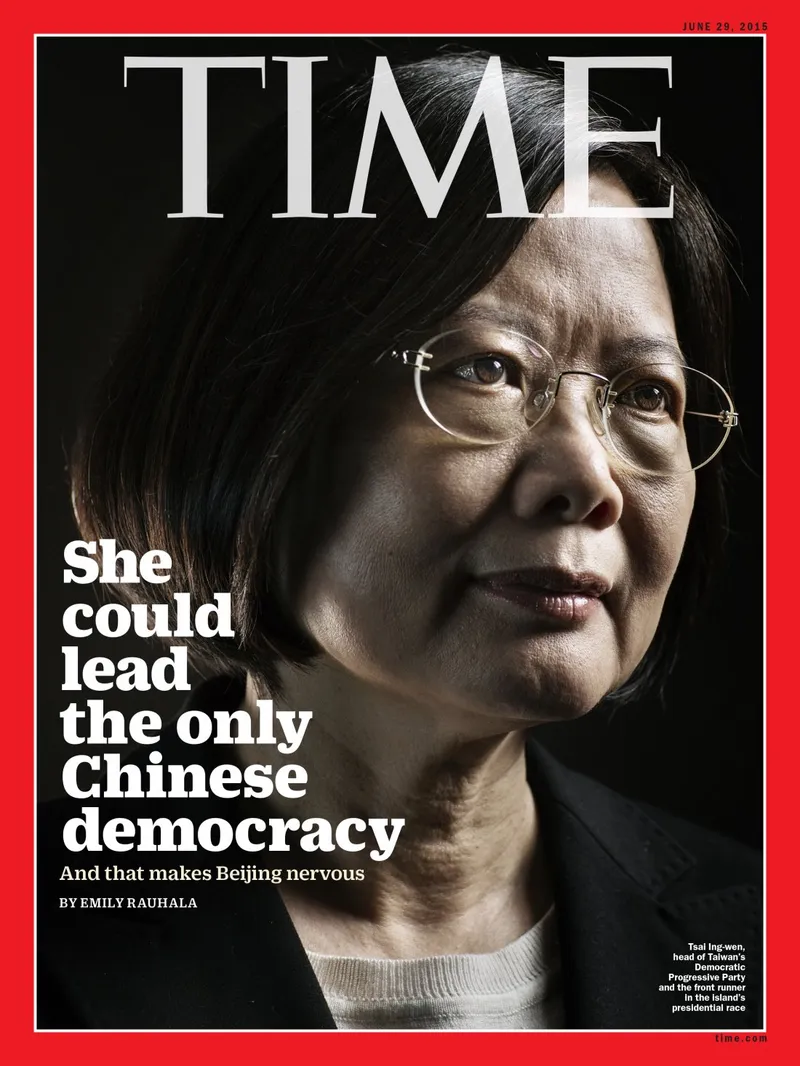
Since the Democratic Progressive Party (DPP) and Tsai Ing-wen achieved “total governance” by securing a legislative majority and the presidency, we have witnessed numerous policy U-turns, an obsession with controlling democratic voting, interference in academic freedom, and the distortion of the essence of law to hunt down political opponents. These actions, which undermine judicial impartiality, have caused the people to question whether the DPP regime deserves to continue its existence.
At this point, perhaps only the most fanatical independence advocates can still stomach the DPP’s self-contradictory and foolish behavior. For instance, when the Labor Standards Act is amended twice in rapid succession only to be spurned by the nation, accepting such a mess can only be described as blind “love.”
Scholar Yeh Kuang-shih has also voiced deep concerns regarding the erosion of democratic and legal values under Tsai Ing-wen. He specifically cited an article published in the New York Times by two Harvard scholars to question Tsai’s damage to democracy.
Yeh noted that the two Harvard political science professors, Steven Levitsky and Daniel Ziblatt—who stand at the pinnacle of political science research—jointly emphasized that for any democracy to survive, it must be built upon two norms that transcend the written law:
- Mutual Toleration: Even if two individuals (or groups) hold differing positions or opinions, they must respect, understand, and perhaps even appreciate one another.
- Forbearance: This refers to the idea that some actions, even if technically legal, should not be taken, to avoid an endless cycle of political retaliation.
The two Harvard professors warned in their piece that if these two norms are destroyed, democracy will follow, collapsing into autocracy.
Yeh further remarked that regardless of whether one agrees with former President Ma Ying-jeou’s policies or performance, most would agree that during his eight-year term, he steadfastly adhered to these two critical democratic norms. However, after only a year and a half of President Tsai’s tenure, the instances of these norms being dismantled are too numerous to count.
Yeh added that the “prehistoric forces” exerted by the Green camp to block President-elect Kuan Chung-ming from taking office at National Taiwan University (NTU) is the clearest evidence of a total lack of mutual toleration and a failure to exercise self-restraint in the use of power.