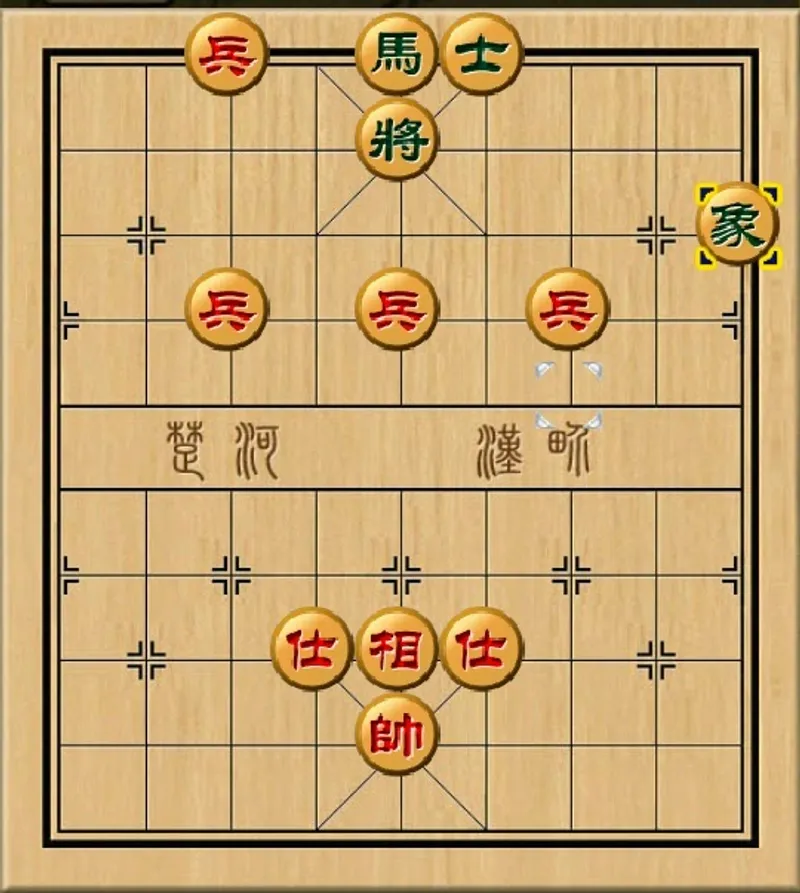
♟️ The Zhenma Chess Game: Understanding the Overall Situation of Ma Ying-jeou’s Political Crisis
Opening Remarks: The Zhenma Chess Game was created by Wu Huanzi, the leader of the Xiao Ge School, and no one has been able to solve it for decades. Wu Huanzi wanted to use the Zhenma Chess Game to find a talented and handsome disciple so that he could pass on his life’s skills to him. However, the Zhenma Chess Game was unexpectedly solved by the Ugly Monk Xu Xu by accident.
Note: Purely for laughs, don’t take it too seriously.
This is a chess game that I came up with in a few minutes out of curiosity, but the more I look at it, the more interesting it becomes. Since some friends said they couldn’t understand this game, let me give you a brief explanation. ---
🀄️ The Chess Game of Ma Ying-jeou: The Three Components of the Political Situation
The overall situation of the game can be interpreted in three parts:
🔴 The Situation of the Red Army (Ruling Party/Challenger)
-
Red Army Pawns: All have crossed the Chu River and Han Border into the enemy camp.
-
Interpretation: This represents that the challenger’s or opponent’s power has penetrated deep into the core, posing a substantial threat or influence to the system.
-
Red Army General, Minister, and Advisors: Together with the Minister and Advisors, they are trapped on the other side of the Chu River and Han Border, unable to cross it, and all gathered in a small frame, watching the battle from the sidelines.
-
Interpretation: The General (President Ma Ying-jeou) is restricted by his own system (**the **Minister, Advisors**, etc., staff or inner circle), unable to act freely or directly cross the boundaries (laws, public opinion, etc.) to launch an effective counterattack, and can only observe the development of the situation from afar.
⚫️ The Situation of the Black Army (Challenged/Defending Side)
-
The Black Army’s General, Horse, and Strategist: The Black Army’s “General” (administrative core) protects the “Horse” (potential successor or key general), with a strategist accompanying the “Horse.”
-
Interpretation: The “General” represents core power or the administrative team, while the “Horse” represents key figures or future hope, supported by surrounding forces (the “Strategist”).
-
The Predicament of the General, Advisor, and Horse: However, the General, Advisor, and Horse are all surrounded by soldiers. Only on the Advisor’s side has a breach been made.
-
Interpretation: The core team is in a predicament of being surrounded by the challenging force (Red Soldiers), but weaknesses or cracks have appeared in the defensive line (the “Advisor”), indicating instability in the internal defenses.
🔑 The Key to Victory and Variables
-
The Only Active Piece (Black Knight): In the entire game, the only piece that can move freely across the Chu River and Han Border is the Black Knight.
-
Analysis: This is Black’s only key piece with mobility, capable of influencing the battle, and offering opportunities for a breakout or counterattack.
-
The Hidden Hope (Black Elephant): Black’s only hope for victory doesn’t rely on the Knight crossing the Chu River and Han Border to directly attack the Red Army’s camp. In this strange game, the only piece capable of influencing which side will advance towards victory is the Elephant, hidden in the corners and waiting for its opportunity.
-
Analysis: The Elephant (perhaps representing public opinion, centrist voters, or some important force outside the system) is the true key to breaking the deadlock. It may not seem to be in the center of the battlefield, but its movement (or shift in stance) can affect the entire situation.
-
Constraints of the Black Elephant: The Elephant’s plans depend on the movement strategies of the other Red Pawns. Otherwise, if the situation isn’t handled well, and the Knight moves out first, or is captured by a Pawn, not only will the Elephant fail to secure a key position, but the entire game will be lost due to the Pawn’s actions. Furthermore, the Elephant cannot cross the Chu River/Han Border.
-
Interpretation: The potential key force (the Elephant/public opinion) depends on whether the main player on the board (the Knight) takes the correct action. If the main player (the Knight) acts prematurely or fails, it will lead to a complete loss.