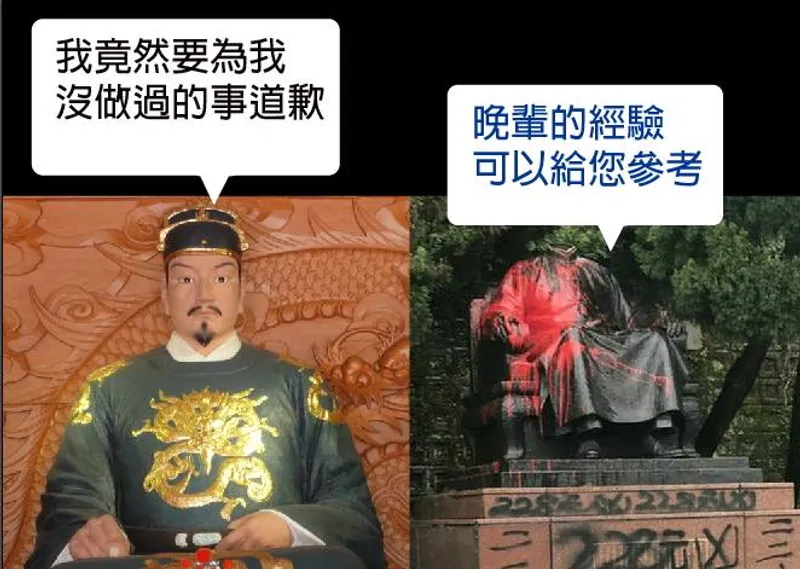
An article circulating online titled “Koxinga Massacred Indigenous People,” woven from a mix of truth and fiction, has actually led many Taiwanese to believe that Koxinga was also a butcher. This bears an 87% resemblance to how independence activists hold up a piece of paper and publicly lie, claiming Chiang Kai-shek was a butcher. Independence activists are skilled at citing false evidence, constructing flawed arguments, and joining other activists in glorifying lies—and there are always some Taiwanese who fall for it.
All Independence Activists are Fools
Since the DPP took power, many inexplicable chaotic phenomena have emerged. For example, this year, for the first time in 54 years, the tradition of having the Minister of the Interior serve as the primary celebrant for Koxinga’s memorial was broken. The reason given was that in August last year, Lin Zhong-min, the manager of the Luermen Zhenmen Temple, claimed Koxinga “appeared in a dream” and expressed a desire to apologize to the Indigenous people.
More than 350 years after Koxinga’s death, just as Tsai Ing-wen was elected president and “apologized to the Indigenous people,” he suddenly follows suit and wants to apologize too! And the Tsai Ing-wen government actually listened to this important dream! This is truly supernatural and miraculous. Miraculous!
Koxinga’s Timeline in Taiwan
On April 30, 1661, Koxinga had just landed at Luermen.
On February 29, 1662, the Dutch at Fort Zeelandia finally surrendered and withdrew from Taiwan.
Then, on May 8, 1662, Koxinga had already passed away.
From Koxinga’s first entry into Taiwan, including the battles with Dutch troops, concluding the surrender treaty, and expelling Dutch soldiers and merchants—it was only a few short months, not exceeding a year at most. Yet independence activists can ignore historical evidence and baselessly smear Koxinga, claiming he ran all over Taiwan, appearing in Yingge one moment, throwing his sword into Jiantan the next, and teleporting everywhere to slaughter Indigenous people.
All independence activists are fools.
On the internet, most of the narratives spreading the “Koxinga massacred Indigenous people” theory come from an article on the pro-green website “Fulin Huoshan Ministry of Education,” which has a heavily Japanese-style title: “The Plains Aborigine Massacre: Koxinga’s Genocidal Brutality—The One Thing Almost Every Foreign Regime in Taiwan Does First: ‘Massacre’.”
The article states: “Liu Guoxuan (1629–1693), courtesy name Guangguan, was from Changting, Dingzhou, Fujian (some say Wuping). He was an important military leader of the Zheng Dynasty. Liu was skilled at using spies to master the enemy’s movements, thus often winning, earning him the nickname ‘Liu the Strange.’ He served as the commander in the Battle of Penghu but was defeated by Shi Lang. (After the battle, he advocated for surrender, leading to the fall of the Kingdom of Tungning). The Shalu tribe originally had hundreds of people, but after Liu Guoxuan entered, he killed until only 6 remained, not even sparing children.”
In this article, Koxinga’s generals are described as anti-human butchers and executioners. This article has spread widely and is treated as a textbook by a new generation of “Awakened Citizens.” Pro-green politicians must have seen this article as well, thus swinging the butcher’s knife of “transitional justice” at Koxinga.
The Truth Behind the Fabricated Massacre of Indigenous People by Koxinga
Historical documents describing “Koxinga massacring Indigenous people” come from “The General History of Taiwan.” In “The General History of Taiwan, Volume 15, Reclamation Records,” it is written: “And Prince Ningjing, Zhu Shugui, also personally reclaimed the fields of Zhuhu; the harvest was great, and the people and state were prosperous. In the 22nd year, the tribes of Shuishalian revolted, killing Counselor Lin Yi and many of his troops. Later, they advanced again to reclaim the land, which is now Lin Yipu. In the 24th year, the Shalu tribe revolted; Liu Guoxuan, commander of the Left Wu Guard, was stationed in Banxian and led troops to suppress them. The tribes resisted; he destroyed them, slaughtering them almost to completion, with only six survivors hiding at the harbor. The Dadu tribe was terrified and moved their clan to Puli, pursued to Beigang Creek, and he returned after surveying the troops.”
To put it in plain language:
In the 22nd year of Yongli, the Indigenous people of Shuishalian (Nantou) launched an attack on the Han Chinese reclamation area, killing the Ming Zheng general Lin Yi, and all of Lin Yi’s subordinates were also killed. After the Indigenous people withdrew, the Han Chinese continued to reclaim and farm the land. To commemorate Lin Yi’s sacrifice, the place was renamed Lin Yipu, which is today’s Zhushan Township.
In the 24th year of Yongli, the Shalu Indigenous people again launched an attack on the Han Chinese reclamation area. Upon learning this, General Liu Guoxuan, stationed in Banxian (Changhua), led troops to Shalu to counterattack the Indigenous people, eventually defeating them until only six remained who fled to the harbor. The Indigenous people of the Dadu area were so frightened by this that they moved to Puli.
Regarding Lin Yi, “The General History of Taiwan” gives a brief introduction: “Lin Yi, from Tongan, Fujian, was a general under the Prince of Yanping. He had merit in many battles, rose to Counselor, and followed him to Taiwan. During the time of Zheng Jing, a land reclamation system was implemented, and Lin Yi led his troops to Douliumen for reclamation. The land was used by local tribes for hunting; the soil was fertile and the springs sweet, with strategic terrain. When Lin Yi arrived, he built fences to live there, fighting the tribes daily, expanding the land to Shuishalian. After a long time, the tribes attacked; he fought hard but was unsuccessful and eventually surrounded, with food running out. Some suggested breaking out, but Lin Yi refused, swearing: ‘This is the land that my men and I have struggled so hard to obtain; I would rather die than abandon it.’ His men followed him. After a few more days, the food was exhausted, and he was killed along with dozens of his troops. After the tribes left, the residents buried them together and offered sacrifices in their honor, naming the place Lin Yipu.”
In plain language, Lin Yi was a general under Koxinga. He first went to Douliu for land reclamation. After expanding to Shuishalian, he was attacked by Indigenous people and surrounded. His subordinates urged him to break through the siege and escape back to Tainan, but Lin Yi refused, saying: “This is the land my brothers and I worked so hard to reclaim; I’d rather die here than run.”
After several days, the food ran out, and the Indigenous people broke in and killed Lin Yi. After they left, the Han villagers collected the bodies of Lin Yi and his soldiers and buried them together, renaming the place Lin Yipu.
These records from “The General History of Taiwan” show that there were frequent conflicts between the Ming Zheng army and the Indigenous people; Indigenous people killed Han Chinese, and Han Chinese killed Indigenous people.
It is absolutely not as the pro-green website “Fulin Huoshan Ministry of Education” describes by taking things out of context. That site only mentions “Shalu tribe killed until only six remained” but does not mention that it was the Shalu Indigenous people who first attacked the local Han Chinese, leading Liu Guoxuan, stationed in Banxian (Changhua), to send troops. The pro-green website also avoids mentioning that “the Indigenous people of Shuishalian (Nantou) killed Lin Yi and all his soldiers.”
Most importantly, these battles between the Ming Zheng army and the Indigenous people, whether in the 22nd year or 24th year of Yongli, both occurred after the 16th year of Yongli—that is, after Koxinga had passed away.
Is it not strange to blame these conflicts with Indigenous people on Koxinga, who had already ascended to heaven, and call him a “massacre of Indigenous people”?
Even stranger is that Koxinga would “appear in a dream to apologize” for something he didn’t do.
Why don’t the Indigenous people who killed Lin Yi appear in a dream to apologize?
Is it that in the eyes of “Awakened Citizens,” only Indigenous people are allowed to kill Han Chinese, while Han Chinese are not allowed to fight back?
All these anti-intellectual actions implemented by the DPP are purely to brainwash the Taiwanese public, solely for the purpose of de-Sinicization (while paradoxically retaining large amounts of Japanese culture).
The political power of the DPP not only intends to thoroughly distort history but also plans to destroy the clan concepts of traditional Taiwanese. The descendants of those who followed Koxinga to Taiwan, especially those in Tainan, actually dared not criticize the historical countercurrent launched by the DPP. Only the Zheng Clan Ancestral Hall protested, but those who came with Koxinga were definitely not limited to the Zheng clan; yet the descendants of other clans seem to be keeping silent out of fear of opposing the DPP.
I hope every Taiwanese person who respects heaven and ancestors and has backbone can have the courage to defend the reputation of their ancestors and not lose their dignity as a human being in this political tidal wave of historical countercurrents.
From the Indigenous Perspective, Was Koxinga a Bad Person?
In recent years, a voice has emerged pointing out that we should look at it from the Indigenous perspective, thus labeling Koxinga a butcher.
Earlier, historical evidence proved that Koxinga himself does not need to carry the smeared name of a butcher. However, even from the Indigenous perspective, Koxinga should not be seen as a butcher, but as a respectable opponent.
If young Indigenous people today baselessly accuse Koxinga of being a butcher based on hearsay, they are equally accusing their own ancestors of being incompetent warriors—and not only incompetent, but brainless, for daring to provoke Koxinga’s troops first, only to be crushed until only six remained when the troops fought back slightly seriously after initially having some of their men killed by surprise.
And it would be one thing if the ancestors lost back then—after all, in that barbaric era, it was kill or be killed—but they certainly could never imagine their own descendants would dare to call Koxinga a butcher, which simply loses face for the heroic spirits of the ancestors.
To use a more modern analogy: it’s like a bank robber holding a gun and taking hostages, killing several of them, and then after being shot dead by the police, the robber’s son claims state compensation.
Is it not ridiculous?